Requiem for the Natural
My own impression at this point is (as he often tells me): "that's not quite right." But I've learned that successfully disagreeing with this theologian is a rare thing indeed.
Pax Christi,
With the arrogance of youth, I determined to do no less than to transform the world with Beauty. If I have succeeded in some small way, if only in one small corner of the world, amongst the men and women I love, then I shall count myself blessed, and blessed, and blessed, and the work goes on. -- William Morris
"In Aristotle, perfection resides primarily in the form and essence of things. To be means to be form or to be determinate. This is why he can so easily rephrase the ancient question 'what is being?' into the question 'what is substance?' (ousia). Thomas remarks, however, that any ousia as such, like humanity or fieriness, can still be considered in the manner of 'not yet in act', thus as somehow distinguished from its 'to be.' A certain form, taken as such (forma signata), can be considered as existing in the potency of matter or in the power of an agent or as known in the mind. According to all these types of 'in-existence' the ousia has an ideal existence in something else, it does not yet enjoy actual existence in itself by reason of its being. Only when it is said to be will the form pass from its ideal in-existence to actual existence in rerum natura. The point Thomas wants to make is that this passing over to actuality is not a mere change of modality which is, as such, indifferent to the perfection residing in the form, but that unless a thing is said to be, its perfection is not (yet) a perfection of its being; its perfection does not make it actually be perfect. This is why esse is siad to be the 'perfection of all perfections'. Any perfection, whatever its determinate character, is a perfection of being.
This is explained further by pointing to the manner in which esse is diversified in things. How should one account for the determinate character of esse as found in this or that particular being? To esse nothing can be added that is more formal, since as principle fo act esse is itself most formal, relating to everything else by way of determining. Nothing can be added to esse which is extraneous to it, because nothing is extraneous to it except non-being. This is the crucial point: the differences of being (such as being white, or being human) cannot be added from outside, since they are differences of being. Even those differences are. This suggests an alternative manner of accounting for the differentiation of being. In each case esse has a determinate and diverse character by the fact that it is the esse received in a nature of a certain kind...The being of a tree is different from the being of a horse. The point now is that those differences (of different natures) are not added from outside to esse, but that those differences are somehow originally included in esse and are 'released' from it. If the differences- that is, the essential perfections of things- are differences of being, then they must differ according to the degree in which they incorporate the perfection of being....From this Thomas concludes that perfections, such as those of life or intelligence, are not so much external additions to the perfection of being but are, on the contrary, 'manifestations' of the perfection of being. And therefore, if a reality is completely determined in identity with its being (ipsum esse subsistens), then being must be present in it according to its full range of perfection, including perfections such as life and intelligence and so on. Thus it appears that in reducing all things, with respect to their being, to the first cause, the categorical differences of being in the sphere of essence are, so to speak, gathered together in their original unity in and as being itself: the simple being of God contains in itself the perfections of all things (of all genera).
As we have observed, de Lubac was not simply providing a novel systematic theology of the supernatural. Restating the authentic doctrine of
However, what complicates the validity of de Lubac’s self-understanding is the manner in which he cites Thomas. It is not always evident that Thomas is expressing the ideas de Lubac presumes in the passages he cites. Few provide enough context to actually establish that de Lubac’s interpretation is unambiguously faithful to the Angelic Doctor. But the most substantial problem in de Lubac’s exegesis is his selective reading. De Lubac draws upon the set of Thomas’s texts which emphasize that man’s only end is his supernatural finality: arguing that the knowledge of God’s essence is the end of every intelligent creature[3] and that no desire of this kind can be in vain.[4] De Lubac thus argues that in Thomas’ view the only end “natural” to man is the supernatural end.[5] As the end is what specifies the nature, and man has only one final end, man is essentially constituted by his supernatural finality.[6] Any thought of a human nature without this supernatural orientation is thus technically of a different species, a different nature all together (hence the failed relevance of any “pure nature”).[7]
Yet as Steven Long points out, de Lubac has overlooked another set of Thomas’s texts which clearly affirm the existence of a natural end distinct from the supernatural end.[8] For
In fact, the natural proximate end is a necessary aspect of the actual Providential order, even as de Lubac himself conceives of it. For in deemphasizing
Even the attempt to distinguish human nature by its inability to achieve the supernatural end through its own powers presupposes an intelligible natural end according to which those powers are defined. In fact, all grace presupposes the natural end in precisely this sense. It secures that upon which grace builds: secures it not in its sterility (as de Lubac thought) but in its integrity. If one were to claim that the proximate natural end were blotted out by the supernatural, and did not endure as distinct within a supernatural ordering, grace would be inherently transmutative of species[14] rather than perfective of it. If the natural end does not endure, then neither does any distinct sense of the term “man.” Grace would not then “prefect man” or “re-order man,” because what constitutes the reality as “man” simpliciter has been dissolved. Grace would actually destroy, rather than perfect nature. It would, metaphysically speaking, render us beings of a different kind. Yet we are called to experience the vision of God as graced humans; to attain the supernatural as transformed humans; to share in the divine nature as elevated humans. If grace is to perfect us as human beings, the natural end that specifies us must endure in its integrity within the order of grace.[15] Anything short of this would equate God’s grace with the cataclysmic Flood that only redeems through destruction. Thus the failure to uphold the integrity of the natural end results in an extrinsicism more radical than that which de Lubac attempts to overcome! For what could be more extrinsic to nature than a grace that cannot even be supper-added to it without destroying it? It seems then in his effort to establish the organic continuity between nature and the supernatural (by positing a supernatural finality to the exclusion of a natural proximate end), de Lubac himself falls prey to either a form of intrinsicism or of extrinsicism, both incompatible with the paradoxical character of the mystery. He thus fails to avoid Scylla or Charybdis, and the true via media that the mystery demands remains elusive.
Having missed the fundamental distinction between the proximate natural end and the final supernatural end, it becomes clearer why de Lubac’s interpretation of
Further, de Lubac’s interpretation of
IV. Respondeo Quicendum Quod: Retrieving the Retrieval
We have seen then that de Lubac’s exegetical shortcomings, primarily in failing to account for the fundamental distinction between a distinct natural (proximate) end within his account of the supernatural, lead ultimately to problematic conclusions that undermine the success of his retrieval and his attempt to find the middle way demanded by fidelity to the paradoxical divine truth. However, it seems that de Lubac’s intuition in searching for answers in the thought of
But it does not merely distinguish.
Sic et non: within Thomas’ framework, an accidental relation need not carry the connotations of compromising unity. “Accidental” need not mean “contingent.” For though it is technically not necessary according to the essence of man; it can easily derive a more eminent necessity from God’s antecedent will for that nature. Thus, from the perspective of faith, the accidental principle can be considered as intimate to man as his hands and his feet. It can, as accidents properly conceived are meant to do, more fully actualize that nature. Perhaps it would be helpful to think of the relationship in terms of proper accidentality: the way we would see having a right hand as intrinsic to man, yet it nonetheless stands “outside of” (extrinsic to) the essence. For if I were to lose my right hand, I would nonetheless retain my humanity. And from the perspective of God’s divine will for creation, having a right hand may be as integral in reality as having an intellect. Grace would not simply “add onto” nature, but would be intrinsic as to unfold into actuality (passive) potencies that lie dormant within nature itself qua spirit. Thus, unity is achieved, but in such a way as to maintain distinction through metaphysical precision.
Such a vision of accidental unity seems to be operative in David Braine’s interpretation of de Lubac. While noting that his chief problem is the ambiguity regarding technical philosophical terminology, Braine believes it is quite easy to separate de Lubac’s intention from his philosophical confusions.[23] Thus he also argues that his attempt to predicate the supernatural orientation (or for that matter sin) of nature is mistaken. What he intends is to predicate such an orientation of man as person in the relationship to a single spiritual community that he shares in virtue of the (accidental) relation of inheritance.[24] The finality does not arise out of human nature qua nature, but rather out of human nature as it is ordered in the divine order of
Though it seems that de Lubac has not succeeded where
Thus we have seen that de Lubac’s overall principles of attempting to find a theoretical form that upholds both poles of the mystery of the supernatural; his criticism of a perverse form of Thomist extrinsicism; and his proper intention to find the resources for his solution in the thought of St. Thomas Aquinas are all aspects of de Lubac’s theology that we must commend. And despite his exegetical insufficiencies and metaphysical ambiguities which led to problematic conclusions, we have found that nonetheless the distinctions of St. Thomas provide a compelling solution and a way to remain faithful to the paradox of divine truth and to the contours of Lubacian theology (in a sense, being more Lubacian than de Lubac!). We might say that with a little touch of Thomism, de Lubac is able to properly fulfill his own aim and give reverence to the mystery of the supernatural.
[1] Braine, pp.558-562
[2] For ease of citation, we will follow Steven Long in drawing all citations of the texts of St. Thomas Aquinas, unless otherwise noted, from the Corpus Thomisticum, S. Thomae de Aquino opera omnia, available in Latin online at http://www.corpusthomisticum.org/iopera.html. Cf. Steven A. Long, “On the Loss, and the Recovery, of Nature as a Theonomic Principle: Reflection on the Nature/Grace Controversy,” in Nova et Vetera, English Edition, Vol.5, No.1 (2007): p.133.
[3] Summa Contra Gentiles (SCG), III, 25; Summa Theologiae (ST) I-II, Q.3, a.8. Cf. Long, p.137.
[4] ST I, Q.75, a.6.
[5] The Mystery of the Supernatural, pp.66-67.
[6] Ibid., p.63.
[7] Ibid., p.68, 71.
[8] ex. ST I, Q.75, a.7, ad.1; Questiones de anima a.7, ad.10. Cf. Long, p.137.
[9] Long, p.146.
[10] Voderholzer, pp.122-123.
[11] Long, p.148: “To say that by nature the human will directly aspires to the hidden life of God is to define it as the divine will alone may be defined. All creation is ordered to God as End, but through the medium of the proportionate natural end for each creature, which is nothing other than a mode of being like unto God.”
[12] Divine simplicity implies that there cannot be more than one divine nature; ST I, Q.11, a.3.
[13] The Mystery of the Supernatural, p.34.
[14] Long, p.153.
[15] ST I-II, Q.5, a.5, ad.3.
[16] Long, pp.140-141.
[17] Quod. I, q.4, a.3, resp.; Cf. Long, p.134.
[18] De Malo, q.5, a.1, ad.15
[19] ex. SCG, III, c.48.
[20] Braine, p.569; Long, pp.138-139.
[21] De Virtutibus, q.1, a.10, ad.13; Long, pp.162-165.
[22] A brief example may help to illustrate: if I had in my hand a small block of marble, we could say that in simply doing what it is the natural end of marble to do, it was functioning according to a natural end. What if I, from the moment of my finding this block of marble (creation), intended to make of it a rook for my chess set, and (via grace) carved it into a chess piece with the new end of performing certain moves and aiding me in winning a chess match. Does the fact that from the beginning I intended for this piece of marble a “supernatural” end involving the actions proper to a chess piece negate the fact that it is still marble, as defined by the end of what is natural for marble to be? Or is it in fact presupposed by my intention and gracious elevation that it must in fact remain distinctly marble in order to even become a chess piece?
[23] Braine, p.567.
[24] Ibid., pp.548-549
[25] Braine, p.564; De potentia, q.1, a.3, ad.1
Confronted with any mystery, however, the intellect is tempted with a deep impatience and is often driven to abandon its vigilance to that harmony by radically favoring one pole at the expense of the other. It develops a rationalizing tendency threatening the “both/and” of the synthesis with a reductive “either/or” which, for de Lubac, constitutes the fundamental attitude of heresy. When de Lubac began writing on the subject of the supernatural as early as 1931, there were before him at least two problematic ways in which the complex character of the mystery was subject to distorting reductions.[5] The first was a form of intrinsicism equated with the immanence of Modernism, as criticized by Pope Pius X in his encyclical Pascendi Dominici Gregis (1907).[6] Such a vision construes faith, and thus the foundation of all religion, as the outworking of internal sentiment. Accordingly religious belief achieves only a subjective character and the public significance of dogma and worship are undermined.[7] Transcendence is thus ultimately contained within the principles of the finite human spirit: in a sense, it never breaks away from the plane of the natural.[8] Modernist immanence[9] thus represents the reduction of the mysterious paradox by radically equating the natural and the supernatural, making the latter little more than a function of the former (or perhaps vice-versa[10]). It achieves unity without distinction.
The second evident threat to the synthesis moves in the opposite direction: by positing a distinction which forfeits unity, and thus reduces to a purely extrinsic opposition between the terms of the paradox. This is the cardinal sin that de Lubac sees stemming not from modern agnostics, but rather from within the Thomist theological tradition. According to de Lubac, beginning as early as the 15th century, St. Thomas’s teaching regarding the natural and supernatural was gradually distorted as doctrines that challenged his synthesis (such as that of Denys the Carthusian, 1402-1471) were introduced into the Thomist tradition as interpretations of Thomas himself: the chief perpetrator being the well-known commentator of the Angelic Doctor, Thomas Cardinal Cajetan (1468-1534). Cajetan’s interpretation led to a conception of human nature that is fundamentally “purified” from the supernatural with an existential trajectory and finality distinct from the vision of God. Nature then becomes a self-contained and self-sufficient order unto itself, to which grace must come only as an intrusion, or an order “super-added” on top of it. The supernatural is ultimately little more than “accidental” to nature: contingent and alien to it; opposed rather than simply beyond; depriving the Catholic mantra “grace perfects nature” of its force. Ultimately in de Lubac’s eyes this brand of extrinsicism paves the way theoretically for the birth of modern atheism, naturalism, and secularism.
De Lubac thus attempts to forge with his doctrine a via media between the Scylla of Modernism and the Charybdis of extrinsicism (equally the progeny of modern error). He seeks to articulate a form of theological intrinsicism that faithfully responds to the “double burden presented by the Gospel, of an utterly gratuitous gift on God’s part coupled with the human person’s profound- non-arbitrary- desire for this gift, both of these being present already at the beginning of each creature’s existence.”[11] It is de Lubac’s task in The Mystery of the Supernatural to avoid the former perversion while adamantly attacking the latter.[12] Seeking to reclaim the fundamental unity between the natural and the supernatural, his thought is guided by a principle adapted from a well-known Scholastic maxim: to counter extrinsicism, one must not only “distinguish to unite,” for “to unite in order to distinguish, is just as inevitable.”[13] Far from a self-conscious “New Theology,” de Lubac saw this program as quite the reverse: he was attempting to recover the traditional teaching to which the Fathers of the pre-modern Church gave witness and bring it into contact with the exigencies of contemporary thought.[14] Thus de Lubac’s explication of the mystery of the supernatural cannot satisfy itself with a purely systematic treatment: it is necessarily a historical enterprise aiming to relocate the theoretical context beyond the poisonous structures of the moderniores. His goal is to reclaim a broadly Augustinian perspective of the supernatural that sufficiently counters the dualists while avoiding the excesses of Bajus and his kin. And yet, for de Lubac the faith is never truly old, never of the past, but is “always new.”[15] One cannot deny the presence of genuine theological progress in that novelty, as if the tradition were simply static and one could ignore all thought in the ages between the Fathers and ourselves. De Lubac’s retrieval of Augustinianism is a sic et non: it is not simply the voice of Augustine he wants to make heard, but more so the voices of the 13th century Scholastics within his tradition. Thus, more properly speaking, de Lubac is seeking an Augustinian-Thomist perspective, enacting a “full return to the thought of
It is the true teaching of
II. Videtur Quod: Beyond Pure Nature
According to de Lubac, when the natura pura was first invoked in the 14th century (in response to the reductive Augustinianism of Bajus), it was “aware of its own artificiality.”[17] It was the result of a hypothetical speculation about God’s omnipotence and the potential for God to have created a human nature with its ultimate end separate from God. It did not initially challenge the understanding that the actual order contained a human nature always already ordained to the beatific vision from its creation. Yet in the 15th century, with the influence of thinkers like Denys the Carthusian- for whom man’s final end lies in contemplating created realities- the former distinction between speculation and reality was blurred. De Lubac points to a change in the conception of nature, which was now defined by an end proportionate to natural powers. In this context, Cajetan proceeded to introduce into the interpretation of
This theology of natura pura was originally formulated in an effort to safeguard the gratuity of grace and the supernatural end. Yet the result, according to de Lubac, was to posit nature and grace as two complete and parallel species within the same genus. Grace could only thus appear as a kind of superstructure: something additional, something accidental, contingent, and ultimately inconsequential.[19] It could no longer perfect, transfigure, or overwhelm the natural order. Consequently, de Lubac argues, natura pura actually fails to ensure the gratuity of the supernatural. The opposition leads inevitably to the conceptual reduction of the supernatural to the natural plane: figuring it always in terms of the natural, as a copy or a “shadow” of it, because the finite end would always remain primary in concept and reality[20] (one sees here the faint specter of Modernism). Further, the theory would need to demonstrate the giftedness of the supernatural in relation to the actual, historical human nature.[21]Yet in contemplating pure nature, one is in fact imagining a wholly different order in which human nature is defined by a distinct, purified finality. It would then only bear an abstract, theoretical “resemblance” to the concrete nature in the actual historical order and would ultimately only establish the gratuity of grace relative to another nature altogether.[22] One can readily see the ultimate failure to uphold both terms of the essential paradox.
In contrast to this, de Lubac argues that a real gratuity must stem from the acknowledgment that in man there is a natural desire that exceeds the limits of natural potency: a desire for the one supernatural end that nature itself is unable to deliver. It can in fact only be desired as an entirely free gift from God.[23] The self-sufficiency of the natural order must be breached in order to be “real;” yet breached in such a way as to always maintain God’s freedom in offering grace. The operative theological principle behind de Lubac’s entire perspective is the unity of God’s Providential economy (the unity that the theology of pure nature implicitly sunders). “His sovereign liberty encloses, surpasses and causes all the bonds of intelligibility that we discover between the creature and its destiny. Nature and the supernatural are thus united, without in any sense being confused.”[24] It is God’s intentionality for His creation, revealed to man, that provides the organic unity between nature and its pre-ordained destiny in the vision of God: the simplicity of God’s antecedent will underlies the distinct gifts of nature and grace. While the natura pura theory conceives of the relationship Platonically (nature and grace relating as if two substances), de Lubac notes that the more proper analogy is hylomorphic: nature and grace relate as if two complementary principles of one substance, one order.[25] It is in their union that they are distinguished.
In expressing this fundamental unity, de Lubac sees himself as freeing St. Thomas’ traditional teaching of the desiderium naturale for the vision of God, which for de Lubac forms the foundation of continuity with the supernatural in the creature. Human nature is, from the moment of creation, called and infused with a dynamism that stretches beyond natural boundaries. For God has ordered man to a single end: as ordained to beatitude, he is specifically distinguished from all speculative hypotheses. While “pure nature” is defined by its orientation to an end proportionate to its powers, human nature as God has actually created it is defined by its orientation to a supernatural end. This orientation underlies all of man’s conscious, finite acts of intellect and will. It is, in fact, as this nature of created spirit (intellect and will) that a sense of “nature” radically foreign to the pagan philosophical concept is established.[26] For only as spirit, created in the image of God, is the concept of nature properly opened beyond its finite limitations. The natural desire for the beatific vision is thus not incidental and “supper-added,” but rather a property of human nature qua spirit: it is “inscribed” or “impressed” on man’s being, something “ontological,”[27] an “essential finality.”[28] What Cajetan and Suarez after him failed to take account of was the utterly exceptional character of the created spirit which infuses the concept of “nature” with a radically different meaning.[29] And it is through the continuity it provides that de Lubac believes he has successfully accounted for both the unity and the distinction implicit in the paradox of the mystery.
[1] Henri de Lubac, S.J., The Mystery of the Supernatural, trans. Rosemary Sheed, (New York: The Crossroad Publishing Company, 1998), p.169: “A synthesis indeed; but for out natural intellect, it is a synthesis of paradox before being one of enlightenment.”; and p.171: “Revealed truth, then, is a mystery for us; in other words it presents that character of lofty synthesis whose final link must remain impenetrably obscure to us. It will forever resist all our efforts to unify it fully.”
[2] Rudolf Voderholzer, Meet Henri de Lubac, trans. Michael J. Miller, (
[3] Voderholzer, p.119.
[4] The Mystery of the Supernatural, p.167.
[5] Ibid., p.xxxv.
[6] Pope Pius X, Pascendi Dominici Gregis:Encyclical of Pope Pius X on the Doctrines of the Modernists, (St. Peter’s, Rome: Sept.8, 1907), http://www.vatican.va/holy_father/pius_x/encyclicals/documents/hf_p-x_enc_19070908_pascendi-dominici-gregis_en.html
[7] David Braine, “The Debate Between Henri de Lubac and His Critics,” in Nova et Vetera, English Edition, Vol.6, No.3 (2008): pp.573
[8] The Mystery of the Supernatural, p.xxxv.
[9] This version of misconstruing the mystery was the distortion de Lubac’s position most clearly boiled down to in the eyes of his critics. We will examine more deeply below what foundations there are, if any, in de Lubac’s thought for such associations.
[10] An example of the supernaturalizing tendency can be found in the theology of Michael Bajus (1512-1589). It was in response to his vision of “everything is grace” that many aspects of the Thomistic distortions were likely formed.
[11] David Schindler, “Introduction to the 1998 Edition” in Henri de Lubac, S.J., The Mystery of the Supernatural, trans. Rosemary Sheed, (New York: The Crossroad Publishing Company, 1998), p.xxvii
[12] For de Lubac, the “separatist thesis” may only have just begun to bear its bitterest fruits; see The Mystery of the Supenatural, p.xxxv.
[13] Catholicism, p. 330.
[14] The Mystery of the Supernatural, p.xxxvi: “Faith must provide the needed answer, and must do so before it is too late to be of help to many.”
[15] Ibid., p.18.
[16] Ibid., p.206.
[17] Voderholzer, p.130.
[18] The Mystery of the Supernatural, p.9.
[19] Ibid., p.178.
[20] Ibid., p.36.
[21] Ibid., p.55
[22] Ibid., p.60: “You may put into this hypothetical world a man as like me as you can, but you cannot put me into it. Between that man who, by hypothesis, is not destined to see God, and the man I am in fact, between that futurable and this existing being, there remains only a theoretical, abstract identity, without the one really becoming the other at all.”
[23] Ibid., p.94. The datum optimum is fundamentally ordered to the donum perfectum; but never in such a way that the donum is guaranteed or demanded (as Bajus thought), but only freely given.
[24] Ibid., p.99.
[25] Ibid., p.32.
[26] Ibid., ch.7, pp.119-139.
[27] Ibid., pp.79-80.
[28] Ibid., p.81
[29] Ibid., ch.6, pp.101-118.
"I think there is absolutely no difference in putting a cross in front of a person's home because of what race they belong to than there is putting a cross in front of our homes because we do abortions."
The meaning of the Resurrection lies, rather, in Jesus' passage to a form of existence which has left death behind it once for all (Romans 6:10), and so has gone beyond, once for all, the limitations of this aeon in God (Hebrews 9:26; 1 Peter 3:18). In contrast to David, but also to those whom he himself raised from the dead, Jesus is withdrawn from corruption (Acts 13:34), he lives for God (Romans 6:10), he lives 'for evermore' and has 'the keys of Death and Hades' (Apocalypse 1:17ff). This event is, as has rightly been said time and again, without analogy. It pierces our whole world of living and dying in a unique way so that, through this breakthrough, it may open a path for us into the everlasting life of God (I Corinthians 15:21ff).Hans Urs von Balthasar, Mysterium Paschale: The Mystery of Easter, trans. Aidan Nichols, O.P., (San Francisco: Ignatius Press, 2000), p.194.

This ultimate solidarity is the final point and the goal of that first 'descent,' so clearly described in the Scriptures, into a 'lower world' which, with Augustine, can already be characterised, by way of contrast with heaven, as infernum. Thomas Aquinas will echo Augustine here. For him, the necessity whereby Christ had to go down to Hades lies not in some insufficiency of the suffering endured on the Cross but in the fact that Christ has assumed all the defectus of sinners...Now the penalty which the sin of man brought on was not only the death of the body. It was also a penalty affected the soul, for sinning was also the soul's work, and the soul paid the price in being deprived of the vision of God. As yet unexpiated, it followed that all human beings who lived before the coming of Christ, even the holy ancestors, descended into the infernum. And so, in order to assume the entire panalty imposed upon sinners, Christ willed not only to die, but to go down, in his soul, ad infernum. As early as the Fathers of the second century, this act of sharing constituted the term and aim of the Incarnation. The 'terrors of death' into which Jesus himself falls are only dispelled when the Father raises him again...He insists on his own grounding principle, namely, that only what has been endured is healed and saved.Hans Urs von Balthasar, Mysterium Paschale: The Mystery of Easter, trans. Aidan Nichols, O.P., (San Francisco: Ignatius Press, 2000), pp. 164-165, 174-175.
That the Redeemer is solidary with the dead, or, better, with this death which makes of the dead, for the first time, dead human beings in all reality- this is the final consequence of the redemptive mission he has received from the Father. His being with the dead is an existence at the utmost pitch of obedience, and because the One thus obedient is the dead Christ, it constitutes the 'obedience of a corpse' (the phrase is Francis of Assisi's) of a theologically unique kind. By it Christ takes the existential measure of everything that is sheerly contrary to God, of the entire object of the divine eschatological judgment, which here is grasped in that event in which it is 'cast down' (hormemati blethesetai, Apocalypse 18, 21; John 12; Matthew 22, 13). But at the same time, this happening gives the measure of the Father's mission in all its amplitude: the 'exploration' of Hell is an event of the (economic) Trinity...This vision of chaos by the God-man has become for us the condition of our vision of Divinity. His exploration of the ultimate depths has transformed what was a prison into a way.

I arise today through a mighty strength, the invocation of theAmen.
Trinity, through belief in the Threeness, through confession
of the Oneness of the Creator of creation.
I arise today through the strength of Christ with His Baptism,
through the strength of His Crucifixion with His Burial
through the strength of His Resurrection with His Ascension,
through the strength of His descent for the Judgment of Doom.
I arise today through the strength of the love of Cherubim
in obedience of Angels, in the service of the Archangels,
in hope of resurrection to meet with reward,
in prayers of Patriarchs, in predictions of Prophets,
in preachings of Apostles, in faiths of Confessors,
in innocence of Holy Virgins, in deeds of righteous men.
I arise today, through the strength of Heaven:
light of Sun, brilliance of Moon, splendour of Fire,
speed of Lightning, swiftness of Wind, depth of Sea,
stability of Earth, firmness of Rock.
I arise today, through God's strength to pilot me:
God's might to uphold me, God's wisdom to guide me,
God's eye to look before me, God's ear to hear me,
God's word to speak for me, God's hand to guard me,
God's way to lie before me, God's shield to protect me,
God's host to secure me:
against snares of devils, against temptations of vices,
against inclinations of nature, against everyone who
shall wish me ill, afar and anear, alone and in a crowd.
I summon today all these powers between me (and these evils):
against every cruel and merciless power that may oppose
my body and my soul,
against incantations of false prophets,
against black laws of heathenry,
against false laws of heretics, against craft of idolatry,
against spells of women [any witch] and smiths and wizards,
against every knowledge that endangers man's body and soul.
Christ to protect me today
against poison, against burning, against drowning,
against wounding, so that there may come abundance of reward.
Christ with me, Christ before me, Christ behind me, Christ in me,
Christ beneath me, Christ above me, Christ on my right,
Christ on my left, Christ in breadth, Christ in length,
Christ in height, Christ in the heart of every man who thinks of me,
Christ in the mouth of every man who speaks of me,
Christ in every eye that sees me, Christ in every ear that hears me.
I arise today through a mighty strength, the invocation of the
Trinity, through belief in the Threeness, through confession of the
Oneness of the Creator of creation.
Salvation is of the Lord. Salvation is of the Lord.
Salvation is of Christ. May Thy Salvation, O Lord, be ever with us.

[AHHHH!!!!] DESTROY him (lusate auton) and get him out of here!!!!! (kai aphete auton hupagein)How embarassing for our Lord and Savior...
Ortho-eidos. As with the good and the truth, the concrete realization of orthoidos can differ according to circumstance; just as the concrete form of truth is found in the correctness of a statement at a given time and place, so the concrete form of the beautiful is found in how fitting a form is as it is used at a particular time and place. Thus “It is raining,” can be correct or incorrect, depending upon the time the statement is made, so a specific form of eidos, such as a specific architectural design, could be legitimate at one place, and, through a change of circumstances, not something which would be proper to reproduce. Changes in how we live will affect the forms of the buildings we construct, and what is appropriate at one time will no longer be the case later. This can be shown by the fact that we no longer need build walls to defend cities.
Matt 9:22: But Jesus turned him about, and when he saw her, he said, Daughter, be of good comfort; thy FAITH hath made thee whole. And the woman was made whole from that hour.This same pattern occurs in Matthew 9:29 and 15:28, Mark 5:34, 10:52, Luke 7:9-10, 7:50, 8:48, 17:19, 18:48. Mark 2:5 (Luke 5:20) reads:
When Jesus saw their FAITH, he said unto the sick of the palsy, Son, thy sins be forgiven thee.
Matthew 8:10: When Jesus heard it, he marvelled, and said to them that followed, Verily I say unto you, I have not found so great faith, no, not in Israel.See also Luke 18:8.
And Jesus said to him, "Receive your sight; Faith OVER/HAVING DOMINION OVER YOU has made you well."Salvation is a result of the cosmic power of Faith man-handling the believer into slave-like submission, dominating the sin out of him or her. The 1st century Judeo-Christian world was all about apocalyptic cosmic struggle, and here it is evident that Jesus was an apocalyptic prophet: attempting to unveil to the world the saving action of Faith, even Faith over him.
"nevertheless knowing that a man is not justified by the works of the Law but through faith OVER/HAVING DOMINION OVER Christ Jesus, even we have believed in Christ Jesus, that we may be justified by faith OVER/HAVING DOMINION OVER Christ, and not by the works of the Law; since by the works of the Law shall no flesh be justified.
Labels: Being, Desmond, Equivocity, Knowing, Univocity
There are, to be sure, several differences in the dialogues between Rome and the Orthodox Churches by the non-Chalcedonians. Of course, this is to be expected, in part because they have far more concerns to work out between their traditions than the Eastern Orthodox have with the Oriental Orthodox, such as, for example, the question of the filioque.[12] There has been progress and the scope of the dialogue has changed, so that in January of 2003 there was a Preparatory Committee established to help create a Joint Commission between the Catholic Church and the Oriental Orthodox Churches,[13] and the first meeting of that commission took place in January 2004.[14]We believe that our Lord, God and Savior Jesus Christ, the Incarnate-Logos is perfect in His Divinity and perfect in His Humanity. He made His Humanity One with His Divinity without Mixture, nor Mingling, nor Confusion. His Divinity was not separated from His Humanity even for a moment or twinkling of an eye.
At the same time, we anathematize the Doctrines of both Nestorius and Eutyches.[11]
On the essence of the Christological dogma we found ourselves in full agreement. Through the different terminologies used by each side, we saw the same truth expressed. Since we agree in rejecting without reservation the teaching of Eutyches as well as Nestorius, the acceptance of non-acceptance of the Council of Chalcedon does not entail the acceptance of either heresy. Both sides found themselves fundamentally following the Christological teaching of the one undivided Church as expressed by St. Cyril.[5]
A clear example of the different uses of the terms hypostasis and prosopon can be found in the Christologies of certain Armenian theologians, who teach that because it is impossible that there be a nature without a hypostasis, one cannot say that the Logos assumed human nature alone from the Virgin Mary, but a human hypostasis and prosopon. To Chalcedonian ears, at any rate, this sounds not like monophysitism but Nestorianism![6]
Jesus himself, at the hour of his Passion, prayed ‘that they may all be one’ (Jn 7:21). This unity, which the Lord has bestowed on his Church and in which he wishes to embrace all people, is not something added on, but stands at the very heart of Christ’s mission. Nor is it some secondary attribute of the community of his disciples. Rather, it belongs to the very essence of this community. God wills the Church, because he wills unity, and unity is an expression of the whole depth of this agape.[2]
Labels: Ecumenical, Henry Karlson, Orthodox

Labels: Beauty, Catholic Worker, Easy Essay, Education, Goodness, Home, Modern, Peter Maurin, Society, Truth, Wendel Berry, Work
"Be not afraid; for behold, I bring you Good News of a great joy... This day is born the Savior", that is, he who, as Son of God and Son of the Father, has traveled (in obedience to the Father) the path that leads away from the Father and into the darkness of the world. Behind him omnipotence and freedom; before, powerlessness, bonds and obedience. Behind him the comprehensive divine vision; before him the prospect of the meaninglessness of death on the Cross between two criminals, Behind him the bliss of life with the Father; before him, grievous solidarity with all who do not know the Father, do not want to know him and deny his existence. Rejoice then, for God himself has passed this way! The Son took with him the awareness of doing the Father's will. He took with him the unceasing prayer that the Father's will would be done on the dark earth as in the brightness of heaven. He took with him his rejoicing that the Father had hidden these things from the wise and revealed them to babes, to the simple and the poor. "I am the way", and this way is "the truth" for you; along this way you will find "the life". Along "the way" that I am you will learn to lose your life in order to find it; you will learn to grow beyond yourselves and your insincerity into a truth that is greater than you are. From a worldly point of view everything may seem very dark; your dedication may seem unproductive and a failure. But do not be afraid: you are on God's path. "Let not your hearts be troubled: believe in God; believe also in me." I am walking on ahead of you and blazing the trail of Christian love for you. It leads to your most inaccessible brother, the person most forsaken by God. But it is the path of divine love itself. You are on the right path. All who deny themselves in order to carry out love's commission are on the right path.
Miracles happen along this path. Apparently insignificant miracles, noticed by hardly anyone. The very finding of a Child wrapped in swaddling clothes, lying in a manger—is this not a miracle in itself? Then there is the miracle when a particular mission, hidden in a person's heart, really reaches its goal, bringing God's peace and joy where there were nothing but despair and resignation; when someone succeeds in striking a tiny light in the midst of an overpowering darkness. When joy irradiates a heart that no longer dared to believe in it. Now and again we ourselves are assured that the angel's word we are trying to obey will bring us to the place where God's Word and Son is already made man. We are assured that, in spite of all the noise and nonsense, today, December 25, is Christmas just as truly as two millennia ago. Once and for all God has started out on his journey toward us, and nothing, till the world's end, will stop him from coming to us and abiding in us.
Hans Urs von Balthasar, “Setting Out into the Dark with God” in You Crown the Year With Your Goodness: Sermons Through the Liturgical Year, trans. Graham Harrison, (San Francisco: Ignatius Press, 1989), pp.275-279
I regard the doctrine of the analogy of being as the invention of Antichrist and hold that precisely because of this doctrine one cannot become a Catholic. At the same time, I believe that all other reasons that one can have for not becoming a Catholic are shortsighted and frivolous.[1]
Rejection of the analogy of being, properly understood, is a denial that creation is an act of grace that really expresses God's love, rather than a moment of alienation or dialectical negation; it is a rejection, that is, of Acts 17:28, and ultimately of Genesis 1:1 (and everything that follows from it). If the rejection of the analogia entis were in some sense the very core of Protestant theology, as Barth believed, one would still be obliged to observe that it is also the invention of antichrist, and so would have to be accounted the most compelling reason for not becoming a Protestant.[2]
[1] Karl Barth, Die kirchliche Dogmatik (KD) I/i: Die Lehre vom Wort Gottes. Teil
[2] David Bentley Hart, The Beauty of the Infinite: The Aesthetics of Christian Truth, (
Labels: Chomsky, Concision, Culture, Information, Knowledge, Manufacturing Consent, News, Poetry, social criticism, Theological Aesthetics, Truth
This appears to be the main, Creative activity of Eru (in some sense distinct from or within Him), by which things could be given a ‘real’ and independent (though derivative and created) existence. This Flame Imperishable is sent out from Eru, to dwell in the heart of the world, and the world then Is, on the same plane as the Ainur, and they can enter into it. But this is not, of course, the same as the re-entry of Eru to defeat Melkor. It refers rather to the mystery of ‘authorship’ by which the author, while remaining ‘outside’ and independent of his work, also ‘indwells’ in it, on its derivative plane, below that of his own being, as the source and guarantee of its being.[1]
For Paul, solidarity or fellowship with Jesus in this life creates a “coporeity” with Jesus that ensures one will share with Him the resurrected state of being. It is one’s union with the historically determined Christ that provides the pattern for His union with the Mystical Christ. This is confirmed by Jesus’ teaching in the Gospels (Mt 5:11-12; Mk 8:35-38; Mt 6:6). Paul comes to identify this corporeity with the (mystical) “Body of Christ” and with the church: Jesus Himself is the firstborn of a new creation, the first to attain the resurrected state among many who are predestined (employing the Jewish understanding of the elect or true people of God) to share in the Kingdom with Him.
But how can one man’s body be thought of as encompassing an entire group of individual people, all with their own animated bodies? As we have seen, the glorified bodily existence of Christ is a spiritual reality that does not conform to natural spatio-temporal limitations; thus, it is possible for Paul to extend the meaning of one person’s body to incorporate a communal sharing in the effects that His spiritual presence has on them. Because the Spirit (or life-giving breath) of Christ is in each of them, their bodies are in a real sense Christ’s: His spiritual body becomes identified with all that is united to His Spirit.
This identification is crucial because it is Christ’s body that underwent crucifixion and resurrection, and as we have seen, these are events that must be transferred to those who hope to attain the resurrection state of existence. As Schweitzer notes:
The Body of Christ is no longer thought of by him [Paul] as an isolated entity, but as the point from which the dying and rising again, which began with Christ, passes over to the Elect who are united with Him; just as, on the other hand, the Elect no longer carry on an independent existence, but are now only the Body of Christ.[1]
In order for Christians to enter the Kingdom, they must undergo death and resurrection just as Jesus did: the pattern enacted in Jesus’ earthly life is carried across space and time into the very life of the believer, and it is according to this pattern alone that he can attain the union he seeks. But for those who are alive, this death and resurrection must have somehow occurred without them actually dying and rising in the physical sense. Thus, it is through sharing in the Body of Christ that the death and resurrection of Jesus Himself is actually transferred to the life of the believer. It is re-lived, re-performed in a new life that is now thought of as Christ’s life, in a new body that is thought of as Christ’s body. The Christian undergoes the very death and resurrection of Jesus in a hidden manner:
But whereas this dying and rising again has been openly manifested in Jesus, in the Elect it goes forward secretly but nonetheless really. Since in the nature of the their corporeity they are now assimilated to Jesus Christ, they become, through His death and resurrection, beings in whom dying and rising again have already begun, although the outward seeming of their natural existence remains unchanged.[2]
The Christian becomes, like Christ, a supernatural being, but in a way that is not yet manifest.
Paul’s mysticism is not only ecclesial in nature (as only occurring through the Body of Christ understood communally), but also has an intrinsically sacramental element. Baptism is the means by which this dying and rising is first enacted, for that is the manner of entering into the corporeity with Jesus. The symbolic structure of Baptism betrays this mystical teaching (as dying and rising). In undergoing a mystical death, the Christian dies to the existential state of “sin,” “flesh,” “the world,” “the Law,” and “death.” Insofar as he is in the Body of Christ, he achieves the status of being on the level of the “in Christ”; the dynamic of a hidden dying and rising is the mechanism through which this occurs.
Mysticism for Paul, then, can be described as the eschatology looked at from within. It is developed from an analysis of the effects that the resurrection of Christ has on traditional Jewish eschatology, and thus is lived out between Resurrection and Return. In this context, the understanding of a spiritual Messiah comes to light: His indwelling (“Christ in us”) takes the form of re-presenting His very death and resurrection in a hidden way within the believer to bring him to the resurrected state; and on the side of the believer (“in Christ”), this can only occur as one partakes of His spiritual body, which is identified with a communal reality (the ecclesia).
II. Conclusion
We have now successfully located in a modern Christology a coherent mystical logic and proceeded to trace its key principles back to their foundational concepts and phrases in the writings of Paul. We then went further and examined these original concepts in light of their concomitant presuppositions and broader theological context. Hopefully, our analysis has formed the first step in a process of illumination by which the mystical dialect of modern spirituality can become more intelligible. In this regard, we see this current project as serving at least three more comprehensive goals: The first is that it lays the foundation of a mystical Christology of the kind that Balthasar constructs: understanding more about the nature of Christ from His mystical relationship with and presence manifest in the lives of believers. Understanding the origin and context of its key notions leads to a deeper understanding of the “spiritual” dimension of Christ’s very being. And no account of Jesus will be complete if it ignores the unique spiritual dimension of His being that is a consequence of His enduring presence in the lives of believers. Secondly, such a study provides a greater understanding of the Christian mystical tradition of the kind exemplified by Maximus, Bernard, Bonaventure, and Julian: making its writings more intelligible and therefore more fruitful for the spiritual growth of the Church. It allows us to understand why and how they articulate the ascent to union with God in terms of partaking in the experiences of Christ, for we now know the precedent set by Paul. These writings can therefore be seen as developments of a theological tradition that goes before them.
Finally, and most importantly, this study has the potential to contribute to the enrichment of spirituality for modern Christianity: making spirituality intelligible for self-understanding, allowing one to more greatly understand and foster a relationship with Christ, to live according to the movements of the Spirit, and to understand one’s own life as grafted into the narrative of Christ’s very life. Indeed, according to Schweitzer, without a general understanding of this mystical element, we cannot have the proper conception of ourselves as Christians.[3] The notions like those that Balthasar puts forth, of seeing the fulfillment of one’s existence in the sharing of Christ’s life and story, this now, according to Paul’s logic, at least becomes a rationally coherent vision and thus a conceptual possibility (not mere fluff or gibberish). If we can make sense of the view that we are in Christ and He is in us, then our entire lives can be consciously structured according to Christ’s. This mysticism provides a means of re-interpretation of all of our experiences, inflecting them with radically new depth and meaning. A primary instance of this potential transformation can be found in our suffering.[4]
If one conceives of his own life as driven by a hidden re-living of Christ’s life, then all of his suffering takes on a new value, a new role, in reference to that hidden reality. It gets grafted, as it were, into the story of Christ. All of our suffering which tends toward the destruction of life is rethought as the expression of that mystical, hidden “dying” with Christ that marks the diminishing of only the natural state of existence. Suffering is reinterpreted as one moment in the eschatological drama, one stage in our transformation into a supernatural state that follows the pattern of Christ’s transformation (death before resurrection). All suffering becomes tied to the hope of resurrection. This is only one instance in which all of life’s experiences gain new and enduring value when one sees his own story as only complete, only properly told, as a sequel; or better yet, a creative retelling of Christ’s story with new characters. Because in reality, Christ truly succeeds in making His story our own.
Labels: Aquinas, Critique, Kant, Milbank, Religion, Social Theory, Sociology, Theology, Theology and Social Theory, William Cavanaugh

Scholars have sought to illuminate Paul’s mystical thought in light of different and varied sources: such as the Greek philosophical mysticism, or the Hellenistic-Jewish mysticism of Philo, or even Gnosticism. But according to Albert Schweitzer, the only context that can make Paul’s mysticism fully intelligible is Late 2nd
The problems begin to arise when Paul is (literally?) knocked off of his horse: in the “
Yet as we have noted, the resurrection state was only supposed to occur when the supernatural age had dawned. Yet Jesus, having died, rose and experiences that state in the present. In short, because of Jesus, Paul is forced to conclude that the supernatural age is dawning even now: between Jesus’ resurrection and return, the natural world-age is intact according to outward appearance; but in reality the powers of the supernatural, resurrected age are already at work transforming the natural world. Between resurrection and return, the natural and supernatural worlds are thought to be intermingled: the natural subsists according to appearance, but the powers of the supernatural are at work in a “hidden”[5] and unmanifest way, as a stage is transformed behind a curtain. This intermingling of the transient and eternal worlds and the dialectic of the hidden and the manifest that result, create the proper conditions for a peculiarly Christ-centered mysticism. It is easier now to see why Paul was forced to conclude to his mystical doctrine as a result of early Christian beliefs about the end time.
In this context, in which Christ functions as the glorified Messiah, the centrality of Jesus for one’s mystical union makes perfect sense. If Jesus expresses the resurrected supernatural state, it is only “in Him” that the powers of that supernatural state can begin to transform the believer in a hidden, spiritual manner. Participation in Christ, the indwelling of His Spirit and living on the new plane of existence that He characterizes become the necessary conditions for attaining one’s destined glory and union with God. Yet, we have stressed the enduring value of Jesus’ earthly experience and the pattern that this lends to His personal presence in the believer. What shape, then, would this necessary participation in Christ take? Jesus Himself did not attain this state by being rapt away to the heavenly realm (as Enoch or Elijah did); but only by suffering, dying, and rising again. It follows that this experience would seemingly have to be repeated by all believers in order to attain that state. This is easy for Paul to conceive of for those already dead; but what of those who are alive? Will they have to die and rise again in order to attain the state of the Kingdom when Christ comes again?
[1] Schweitzer, p.39
[2] N.T. Wright, What
[3] Schweitzer, p. 92-94
[4] Ibid., p.95
[5] One must recall that the original meaning of the term “mystical” simply denoted something “hidden.” It is in this broad sense that Paul’s thought can be designated as mystical.
"Pascal suggests that Atheism displays a certain vigor of soul, but also that there is a religious faith whose vigor exceeds even this atheistic vigor. The dialogue of the soul with itself is the dialogue of the soul with what is other to it, with what exceeds it. Our dialogue with what transcends us will never cease, even when we say there is nothing there. The conversation, holy and unholy, is resurrected in the emptiness. We find vigor for it because we are first invigorated. The promise of being religious is recurrently resurrected because it is constitutive of what we are, what we are given to be, and what we are to be."


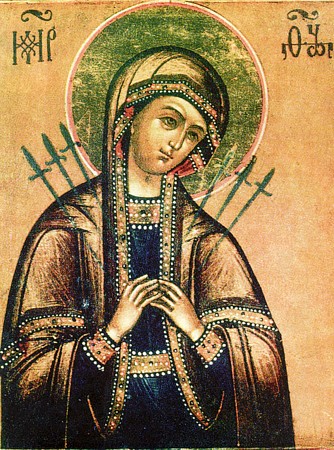
Yesterday the Church celebrated the Feast of Our Lady of Sorrows. It is under this title that Mary was designated patroness of the Congregation of the Holy Cross, so I was able to celebrate the feast consistently during my time at Notre Dame (the Holy Cross priests put on a very nice mass at the Basilica of the Sacred Heart). I came to identify more and more with this feast and decided that under this title I would have my own devotion to Mary. In short, this feast is particularly meaningful for my spirituality. The Mater Dolorosa has been the primary image I've had of Mary for some time now.
The image of the sorrowful Mary is drawn from passages such as Luke 2:35, wherein Simeon meets the mother and her child at the
There is then, of course, John 19: which depicts Mary at the foot of the cross. Here the "beloved disciple" takes the place of Jesus Himself in the familial bond with his mother. Mary, unlike the Eleven (or Ten, if the "beloved" is identified as John), remains with her son as He hangs in agony from a tree, undergoing in Himself the climactic judgment of God upon
I believe it is here, at the Cross, that Mary shows her true colors. It is where she is at her "most Biblical," in my opinion. In a conversation with a Methodist friend a few weeks ago, I was reminded that the Gospels are not exactly brimming with explicit, dogmatic pronunciations about the Holy Mother of God. There are even passages that seem to cast Mary to the margins: for instance, Matt 12:48 depicts Jesus calling Mary's status as family into question. Who is my mother, he asks (fourth commandment, anyone?!). Yet in John's Gospel, it is at the foot of the cross that Christ confirms Mary as his true mother precisely when He presents her as the mother of His beloved disciple (John 19:25).
I recently read Jon Levenson's fantastic book The Death and Resurrection of the Beloved Son. In the last chapter, "The Revisioning of God in the Image of Abraham," Levenson describes beautifully how the Gospels pick up on the ancient Canaanite myths of gods sacrificing their sons and receving them back again; though filtered, as it were, through long-standing Jewish tradition and specifically the famous story of the "binding" of Isaac. John 3:16 recalls the Canaanite trope, but refashioned in the image of Abraham. For as with Abraham, the sacrifice of the beloved son is not a matter of military conquest or survival, but a matter of love:
Here, as in Rom 8:32, the underlying identification of Jesus as the son of God has brought about a refashioning of God in the image of the father who gives his son in sacrifice. The father's gift to God has been transformed into the gift of God the Father.[1]
This got me thinking: it seems that in many ways, the Gospel vision of Mary could be seen as fashioned in the image of Abraham as well. The parallels are by no means perfect, but they are intriguing. Both Abraham and Mary receive promises from God about the miraculous conception of their children in seemingly impossible circumstances. Mary is a virgin, Abraham is a geezer, and Sarah is aged and barren. Both promises speak of the future glory of their children: kings of people will come from Abraham by Sarah (Gen 17:6, 16) and the one born of Mary will be given the throne of David and rule over the house of Jacob with an unending kingdom (Luke 1:32-33). Abraham's reaction of utter disbelief ("Will a child be born to a man one hundred years old ? And will Sarah, who is ninety years old, bear a child?"- Gen 17:17) is mirrored by Mary's more moderate response: "How can this be, for I am a virgin?" (Luke 1:34). In either case, the chosen figures are called to trust in the unimaginable power of God: "Is anything beyond YHWH?"(Gen 18:14); "Nothing will be impossible with God" (Luke 1:37). And both characters come to embody the response of total trust that God will fulfill His promises: Abraham's "Here I am" (Gen 22:1) and Mary's "Behold, the bondslave of the Lord..." (Luke 1:38).
If such parallels point to a common trope, then it follows that Mary's experience at the cross can be read in terms of Abraham's call to offer his "beloved son" as a sacrifice. In Genesis, God has attempted a new means of spreading His primal blessing to the world of His creation: election. Abraham was chosen as the vehicle of God's blessing to all of the nations. In a very real sense, God has taken a risk: the blessing of all of creation depends upon the faithfulness of Abraham to his God. In this context, the story of the aqedah or binding of Isaac becomes the supreme test of Abraham's covenant-fidelity (Gen 22:1). God is commanding Abraham to bleed and burn the "only" son whom God has promised as the future of Abraham's line and glory. To both slaughter his child and believe that the promise will come true nonetheless requires the boundless faith in nothing less than this: that nothing, absolutely nothing, is beyond the power of YHWH. Abraham thus proves his faith to God, proves that he is "in awe of God" (Gen 22:12), by raising his hand against his son and truly offering him as a sacrifice; and God is able to save the child's life, returning him to his father "resurrected," as it were. God then emphatically reaffirms that he has made the right choice with this man, and reestablishes him as the vessel of blessing and future glory (Gen 22:16-18).
What then of Mary's faithfulness to the promises given her? Much like in Abraham's case, the situation presented by God is practically unthinkable. God had assured Mary that her only, beloved son would reign on the throne of
We might then see Mary's place at the crucifixion as a trial similar to that of the aqedah, in which she too is faced with the sacrifice of her only son and must not "withold"Him from God (Gen 22:12), but rather give Him up (as God Himself does). Granted, in contrast to the story of Abraham, Mary is not actually performing the sacrifice of her child. There was little Mary could have done about the crucifixion. And yet, the scene can still be described as a testing of Mary's faithfulness to God's promise and His plan for her. This, it seems, is what Simeon meant when he told her that her heart would be pierced: the passage speaks of the sword as an instrument of judgment or testing, something that reveals what is truly in the heart. In seeing her only son suffer and die, God is testing her heart as if dissecting it with a sword. Christ taught that He would not be ashamed of those who were not ashamed of Him when he came in His Glory (Luke 9:26); the Apostles were ashamed and abandoned him. Yet Mary was not ashamed. Christ taught that only those who do the will of God are His brothers and His mother; His so-called brothers hid themselves from His face like Adam and Eve hid from the face of God (Gen 3:8). Yet Mary remained face-to-face with Him and thereby enacted her trust that God was not mistaken about her son. Mary's presence signaled her trust that, against all appearances, the cross did not prove Jesus' kingship impossible. She thereby, like Abraham, enacted her faithfulness, fulfilling the pledge of trust she made when God's promise was proclaimed to her. In a very real sense, she does the will of God for her: and it is thus only at the cross that Mary proves herself to be the mother of Christ.
Yet Abraham was stopped short of killing his son. His faith only had to stretch so far. Mary's, on the other hand, was called to prove itself even in the face of her son's death! He not only suffered humiliation and defeat, but succumbed to death! How great her trust had to be! And miraculously, it is rewarded: just as Abraham received His son back and his vocation as the vehicle of blessing was reaffirmed, so too does Mary receive her son back to life anew. Resurrected, the promise of God is fulfilled when Christ ascends to the throne of God.
The sorrows of Mary's passion, I believe, are therefore of great import. I think it is in this sense that we are called to a Marian spirituality in the Church: a call that is at the same time the fulfillment of that covenant-faith, that reckless trust in God, that began with Abraham. Through Mary's faithfulness, the blessings of Christ extend to the whole world. We as members of the new covenant are called to enact the same radical fidelity to the promises God has given us. We are, in this sense, called to live our lives from the Cross. Even our theology is meant to be, in this sense, Marian in nature. Henri de Lubac describes all theology as Theologia a Cruce: theology from the cross: "For it is the Cross which disperses the cloud which until then is hiding the truth."[2] The space which we are called to occupy is that of Mary at the foot of the cross, in her sorrow. For that is simply to embody the kind of faithfulness that God the Father Himself lived out in sacrificing His Son for the love of the world. Here, Mary is transparent to God: she is the way to imitating Him. And if we can embody that nearly senseless trust in God, we will receive the Son back again, resurrected and fulfilling the promises that God has made to all Christians. As the "beloved disciple" can be seen as the ideal disciple of Christ, John is showing us precisely where we are to receive Mary as our mother.
Our Lady of Sorrows represents for me a Mariology that is truly Scriptural and, well, truly true.
May she pray for us all, that we may be made worthy of the promises of Christ...
Pax Christi,
[1] Jon Levenson, The Death and Resurrection of the Beloved Son: The Transformation of Child Sacrifice in Judaism and Christianity (New Haven and London: Yale University Press, 1993); p.225
[2] Henri de Lubac, Catholicism: Christ and the Common Destiny of Man, trans. Lancelot C. Sheppard and Sr. Elizabeth Englund, OCD (San Francisco: Ignatius Press, 1988); p.179
But it is not the spiritual that is first, but the physical, and then the spiritual. The first man was from the earth, a man of dust; the second man is from heaven. As was the man of dust, so are those who are of the dust; and as is the man of heaven, so are those who are of heaven. Just as we have borne the image of the man of dust, we will also bear the image of the man of heaven. (1Corinthians 15: 46-49)[1]
I. The Fundamentals of Paul’s Mystical Thought
A. “Christ in Us”
The mystical utterances that speak of Christ somehow living once more in the believer can be traced back to the core mystical concept in Paul designated by the phrase “Christ in us.” This phrase occurs in a number of contexts with slight variations in form, such as in Rom 8:9-10: “And if Christ be in you, the body indeed is dead, because of sin…” Parallels include Eph 3:16: “that Christ may dwell in your hearts through faith,” and 2 Cor 13:5: “Do you not realize that Christ Jesus is in you…” With this phrase, we see a concept of Jesus somehow dwelling within believers in varying degrees. Indeed, it is a concept of Christ’s life actually enduring in the very life of the believer, the supreme example being Gal 2:19: “with Christ I am nailed to the cross. And I live, now not I; but Christ liveth in me…” Here one can see the connection with a real participation in Christ’s crucifixion. Further, Alfred Wikenhauser identifies the “inward man” (ό εσω ανθρωπος) of 2 Cor 4:16 with “Christ in us” of Gal 2:20 and
According to Wikenhauser, the indwelling of Christ is equivalent to the indwelling of the Spirit of Christ (Rom 8:9; Gal 4:6), which is also identified with the Spirit of God in men (1 Cor 2:16). Thus to call Christ one’s vital principle, the source of this new life, is truly to designate Christ’s Spirit as one’s vital and animating principle. Spirit is, as it were, the mode that Christ’ life has when we say that it is “in” someone.
This identification with the phrase “Spirit of God” is of the utmost importance for Paul’s mystical vision. Paul seems to employ it in a few different contexts which suggest different referents. For instance, it can denote the impersonal and all-pervading power of God in things (2 Cor 6:16; cf. 3 Kgs 18:46 and Ez 3:22). Other passages suggest it is a distinct Personal entity (consistent with the Gospel vision) which orthodox Christianity came to formulate explicitly and dogmatically. Though Paul uses the concepts of the indwelling of the Spirit and the indwelling of Christ seemingly interchangeably, there are a number of passages which highlight the distinction between the two, as certain predicates and actions can only apply to Christ. For instance, the Father achieved redemption through the Son; Christ died on the Cross, not the Spirit; man is conformed to the image of the Son, not the image of the Spirit, etc.[3] Yet according to Wikenhauser the term can also refer to the Spiritual Christ: referring to the supernatural state that Christ possesses in His glory. Paul does not ascribe to any Platonic dualism of body and soul; Christ as a glorified body simply is a living spiritual being in a state of existence beyond spatio-temporal bounds. Evidence for this reference to Christ’s supernatural state can be found in 2 Cor 3:17: “The Lord is a Spirit;”[4] as well as 1 Cor 15:45: “the last Adam [was made] into a quickening spirit,” referring to His freedom from the state of corruptible flesh, space, time, age, and death.[5] As Wikenhauser notes:
Paul can use the expressions which he does, because he regarded Christ Triumphant as a spiritual being free from the limitations of time and place which bound Christ during his life on earth.[6]
Thus, for Christ to be “at the right hand of the Father” and “in all believers” are not incompatible states, because His embodied state is of the form of an entirely new creation; a new infusion of divine breath into flesh. His is a body whose relation to spatio-temporal bounds has been radically redefined. So the glorified Christ, as a spiritual entity, can be “present” in a way the earthly, pre-Resurrection Jesus cannot; i.e. in many places and enduring across time.
Because Christ is conceived of as a spiritual being, His indwelling can be considered as analogous to the indwelling of other spiritual beings in Paul’s historical-religious context. One paradigm with which to compare it is the “indwelling” of demonic possession: a demon is said to be “in” someone because it is not an entity governed by the same constraints of space and time, and is thus able to localize itself to a person’s body and enact an influence over the entire physical, psychological, and spiritual being of the man. The demon is as a ungodly wind breathed into the flesh, moving its members like branches in the breeze. Paul conceived of Christ’s indwelling in much the same way, as a living and operative reality within man that is nonetheless distinct from him (Rom 8:16: “the Spirit Himself testifies with our spirit…”) yet enacts a profound influence over his ethical life. Thus, being a Christian can be thought of in terms of being morally possessed by the Spirit of Christ.
It is important to note that in His glorified state, Christ is identified with the power/Spirit of God, but not in a pantheistic way in which He is absorbed and his personality is jettisoned. Rather, it is crucial for Paul that the Christ who dwells in men retains his essential peculiarity. It is his unique vision (likely drawn from the resources of Jewish Apocalypticism) in which the spiritual Jesus does not leave His bodily existence behind, but His flesh, His wounds, and all the particularity of His earthly existence are translated into the spiritual state and integrated with it. The shift to the spiritual state somehow upholds the peculiar features and experiences that defined Jesus within space and time, within a historical and cosmic narrative. It is like a story now becoming legendary and timeless but retaining all of its contextual idiosyncrasies. As Wikenhauser points out:
Christ who is present in Paul is not merely a power or some kind of principle, He is the historical person with His individual character and His own experiences. When Paul says that Christ is in him, he means that this individual person is present in him.[7]
It is as if the historically bound events of Christ’s life were now inscribed into a state beyond time and space. This enduring peculiarity of Christ’s earthly experience in the glorification of His flesh accounts for the way in which Paul’s union is experienced in terms of a “re-living” of the events of Christ’s earthly life. Further, this identification allows for a conception of what we might call the Mystical Messiah: the peculiar narrative of Christ as Messiah can be relocated and re-presented in the lives of others in virtue of Christ’s spiritual state and His ability to, as it were, relocate Himself into the lives of others.
B. Being “In Christ”
The far more common mystical phrase in Paul’s writings is “in Christ,” which occurs 164 times in his Epistles! This notion is intimately linked with “Christ in us,” just as for Balthasar Christ’s re-living presence in believers was mirrored by the participation of those believers in Christ. For Paul, it is only because Christ Triumphant is a spiritual being that he can conceive of men “participating” in the reality of Jesus. Thus, as before, the notion is used in conjunction with the phrase “in the Spirit” (Rom 8:9).
In Pauline theology, to be “in Christ” always refers to the principle of one’s life and action, and is contrasted with the phrases “in the flesh,” “in sin,” “in the Law,” etc. (Rom 7:5; Rom 8:8; Col 2:20; Rom 2:12; Rom 3:19; Rom 6:2). Consistent with Paul’s understanding of spiritual indwelling, the word “in” in each of the above notions can be replaced with the phrase “under the influence of.”[8] When Paul says the Christian is “in Christ,” he means that now the Christian lives on a new plane of existence ushered in by the presence that the Spirit of Christ attains in him. Christ’s spiritual indwelling means that Christ’s Spirit (which is God’s Spirit), or rather His life-principle, becomes the life and breath of the Christian, and the animating force of his actions and being. If we see how the notion of spirit in the Old Testament is often tied to “breath,” and thus life-force, it is easy to see that if Christ’s Spirit becomes our inner breath, we are quite literally new creations. This divides life across two contrasted periods: 1) the level in which the principle of one’s life is “sin,” “flesh,” “the world,” “death,” etc., a condition which for the Christian is in the past; and 2) the level in which the principle of one’s life is Christ’s vital power (also described as being “in the Spirit”). Thus being “in Christ” can be described as a new state of existence in which one’s entire being is under the influence and power of the Spirit of Christ which really and truly dwells in him as a non-physical entity: a personal force principally expressed through motivation in the ethical realm.
We now know broadly the logic behind Paul’s mystical rhetoric. But we don’t as yet know where these concepts come from or the context in which they were born. And this context could provide certain constraints or new horizons: how we can and cannot employ these terms in a constructive theological project. So we must now turn to the context within the context: the conceptual milieu in which Paul found himself.
[1] Props to Didymus IV for bringing the 1 Cor 15 passage (ad the Blake painting) to my attention: http://paultocorinth.blogspot.com/2007/09/but-it-is-not-spiritual-that-is-first.html
[2] Alfred Wikenhauser, Pauline Mysticism: Christ in the Mystical Teaching of St. Paul (New York: Herder and Herder, 1960), p.44
[3] Taking into account passages of distinction, Wikenhauser holds that the unity of Christ and the distinct Person called the Holy Spirit occurs in their coincidence of activity: it is only through the work of the Holy Spirit that the spiritual Christ becomes present in believers. Cf. Ibid., p.84; see also George Maloney, S.J., The Mystery of Christ in You: The Mystical Vision of Saint Paul (New York: Alba House, 1998), p.64-65
[4] Traditionally, in the Old Testament, the spirit is the mode through which God dwells in and acts through men.
[5] See also the following 1 Cor 15:46-49
[6] Wikenhauser, p.89
[7] Ibid., p.74
[8] Ibid., p.52

However, much of the language surrounding these mystical accounts of Christ is notoriously ambiguous and theoretically unintelligible. Many phrases and descriptions of spirituality, which have become common in the broader Christian tradition, seem to strike the ear with a deceiving familiarity. For they truly signal a divorce from their original home, the context in which the concepts and words were rendered intelligible. They are, it seems, much like immigrant concepts: all around and familiar yet always somehow foreign. For I have long wondered what exactly people mean when they ask “Do you have Christ Jesus in your heart?” or when they say “I am united with God in the spirit.” It seems obvious that the supernatural content of these utterances require a stretching of language beyond our normal meanings and senses. But an account of how this language is stretched and how to make it intelligible is rarely provided. While the tradition has preserved the concepts and the rhetoric of the past, it has not always preserved the context which those concepts and that rhetoric grew out of. We shall thus seek to discover the precedent within the Christian theological tradition for these mystical concepts that center around Christ specifically. Yet to gain a clearer understanding of how these notions function within our own time, before turning to the origins, we shall use as a point of departure for our study the Christology of Hans Urs von Balthasar.
A. Balthasar and Christology “From Within”
Hans Urs von Balthasar conceives of Christology in a way that is unique in modern theology. Rather than approach the Gospels with a hermeneutic geared toward emphasizing Christ’s divinity (“Christology from above”) or His humanity (“Christology from below”), he offers an approach that bridges the false dichotomy by exploring the insight about Christ that is revealed in the lives of the saints and mystics of the Christian tradition: what Mark McIntosh calls a “Christology from within.”[1] According to Balthasar, the saints and mystics have a special access to the inner reality of Christ because their existence is defined by a dramatic participation in Christ. They therefore become icons to the Church, windows into the reality of Christ providing data for the systematic reflection of Christology analogous to and consistent with the Scriptural deposit. They offer a vantage point of Christ’s divine-human existence from the inside out. This Christology is then a study of Christ insofar as He is made present in the very lives of believers.
Balthasar is able to think along these lines because according to Him Christ has a uniquely open and inclusive existence: He is able to offer participation in Himself and even in the experiences of His earthly life. As Balthasar puts it: “The individual historical existence of Christ can be so universalized as to become the immediate norm of every individual existence.”[2] This is no external imitation, but a profound sharing of Jesus’ own consciousness. Just as the sacraments (namely, the Eucharist) make present events of Christ’s life that stand in new relations of time and space, holiness in Christians is seen as a constant re-presencing of Christ unfolding in every age. And for Balthasar, the saints and mystics are given to us for the sole purpose of enlightening the Church about the inner reality of Christ, that our understanding of the faith may increase as well as our charity. As every Christology bears the imprint of some community’s experience of Jesus, Balthasar’s Christology can be said to emerge from the community’s experience of Jesus in the mystical union which somehow shares His life with the holy. McIntosh notes:
Through the saints, each moment of Christ’s existence is made continually and really present in
…shaped and structured and completely conditioned by certain categories. The framework of its meanings is constructed of the situations (the interior situations) of Christ’s earthly existence. Man cannot fall out of this space which is Christ’s, nor out of the structural form created by his life.[5]Thus, the pattern of Christ’s saving actions informs and reveals the very structures of fulfillment written into the nature of man from His creation. The believer only finds the actualization of his own existence to the extent that he lives according to this mysterious union, allowing the life of Christ to structure his entire being. Christ’s salvific acts have the capacity to actively generate related situations in the life of the believer, such that his transformation and union with God can only be thought of as a movement from self to “Christ-self,” from revealing only oneself to making Christ’s life present again through one’s own life. This is the very nature of the unique Christian mystical ascent.
We can thus see how Balthasar finds resources for a unique Christology and for an account of spirituality that can only be articulated in terms of this union with and participation in the life of Christ. He grounds these accounts on notions of Christ’s life as uniquely open to participation, somehow beyond time and space, able to exist again in the very lives of believers and create in them related situations (such as his dying and rising). Further, he provides an account of how the self-realization of all created humanity comes only through conforming to these patterns of Christ’s life and by making Him present once more. His theory is coherent and illuminating, and represents the kind of constructive theology of Jesus that the Christ-centered mystics presuppose. But our pursuit of intelligibility cannot rest in the immediate theological justification. We are forced to ask: what foundation does such an enterprise have in the theological tradition? What precedent is there for conceiving of Christ’s existence as mysteriously “open to participation” and of the believer as partaking of Christ’s very life? How can one “participate” in someone else’s life that has already been lived? What is the nature of this union and what implications does it have for the existence of the believer? In short, Balthasar’s account presupposes the intelligibility of these concepts within their native context. We must then trace them back to understand what lends this theological dialect its coherence in the first place.
B. Paul as Source of a Theological Tradition
The first signs of a mysticism that is oriented specifically to a mystical union with Christ is found in the theology of
[1] Mark McIntosh, Christology From Within: Spirituality and the Incarnation in Hans Urs von Balthasar (Notre Dame: University of Notre Dame Press, 1996), p.21
[2] Hans Urs von Balthasar, A Theology of History, 2nd ed. (New York: Sheed and Ward, 1963), p.79-80; cited in McIntosh, p.21
[3] McIntosh, p.26
[4] Ibid., p.25: “saints have been granted a capacity to witness to the ever-new, ever-deeper dimensions of Christ’s living, dying, and rising.”
[5] Ibid., p.22
[6] Albert Schweitzer, The Mysticism of Paul the Apostle (New York: The MacMillan Company, 1956), p.13
Labels: Beauty, Nature of Theology, Prayer, Spirituality